


 276 / 762

276
Chapter 7: Probability
observing a head will be 3/10 = 0.3
, which is not the same as 0.5. If,
however, we flip the coin a large number of times, we would expect about
50 percent of the flips to result in a head.
Observe that
That is, chance or probability can be measured by relative frequency in
which the trials are exactly repeatable, as in the case of tossing a coin a
repeated number of times. Thus, the probability of an event occurring can
be measured by the proportion of times the event occurs if the process is
repeated a large number of times. This is called the
long-term relative
frequency
of the event. This also called the
empirical probability
of the
event.
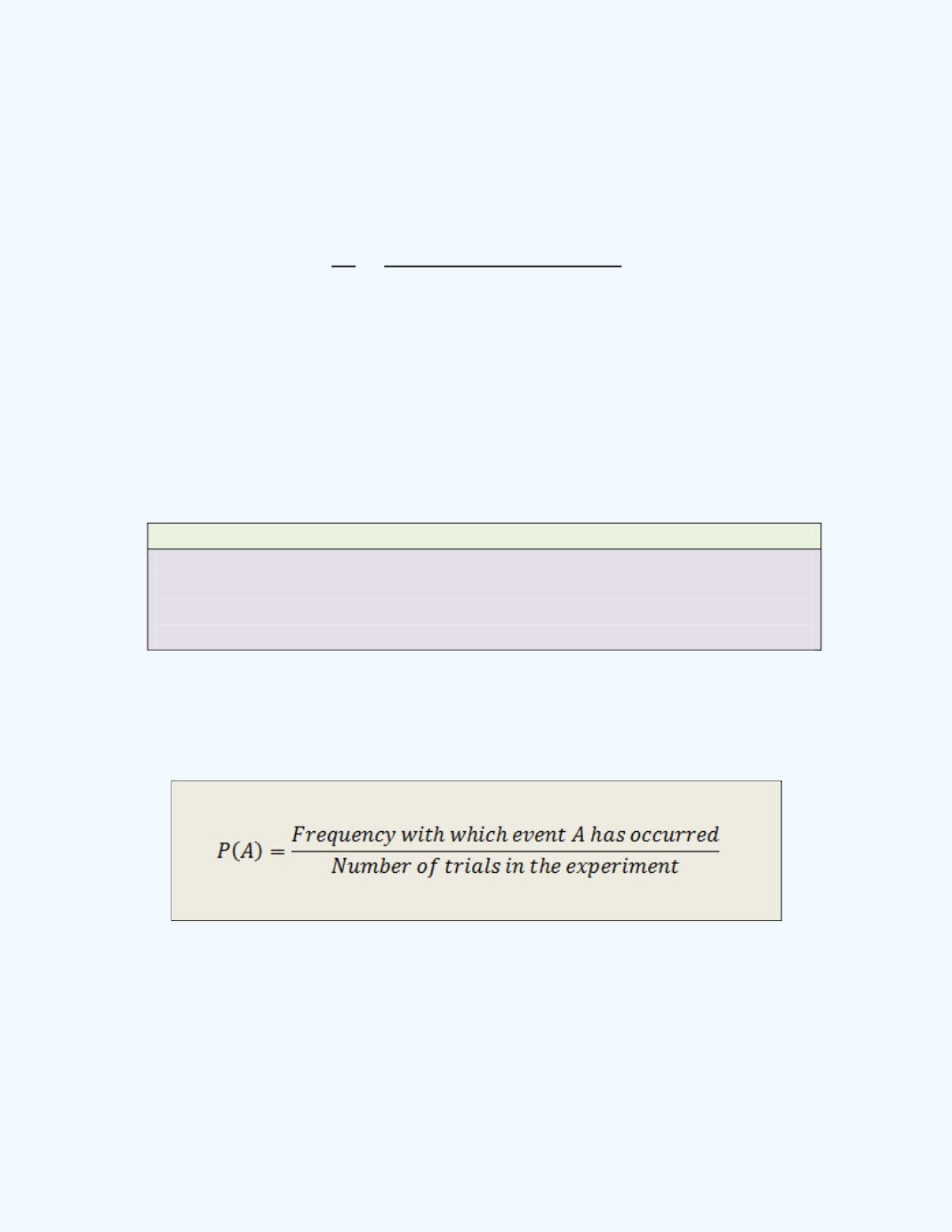
Definition: Relative Frequency or Empirical Probability of an Event
The relative frequency probability of an event is the proportion of times
the event occurs over a given number of trials.
If
A
is the event in which we are interested, then the relative frequency
probability of
A
, denoted by
P
(
A
), can be computed from the following
relationship.
Example 7-9:
Consider an experiment in which a regular six-sided die is
tossed 50 times and a six is observed five times during the experiment.
Based on this experiment, what is the probability of a face of the die not
showing a six?