


 722 / 762

722
Chapter 16: One-Way Analysis of Variance
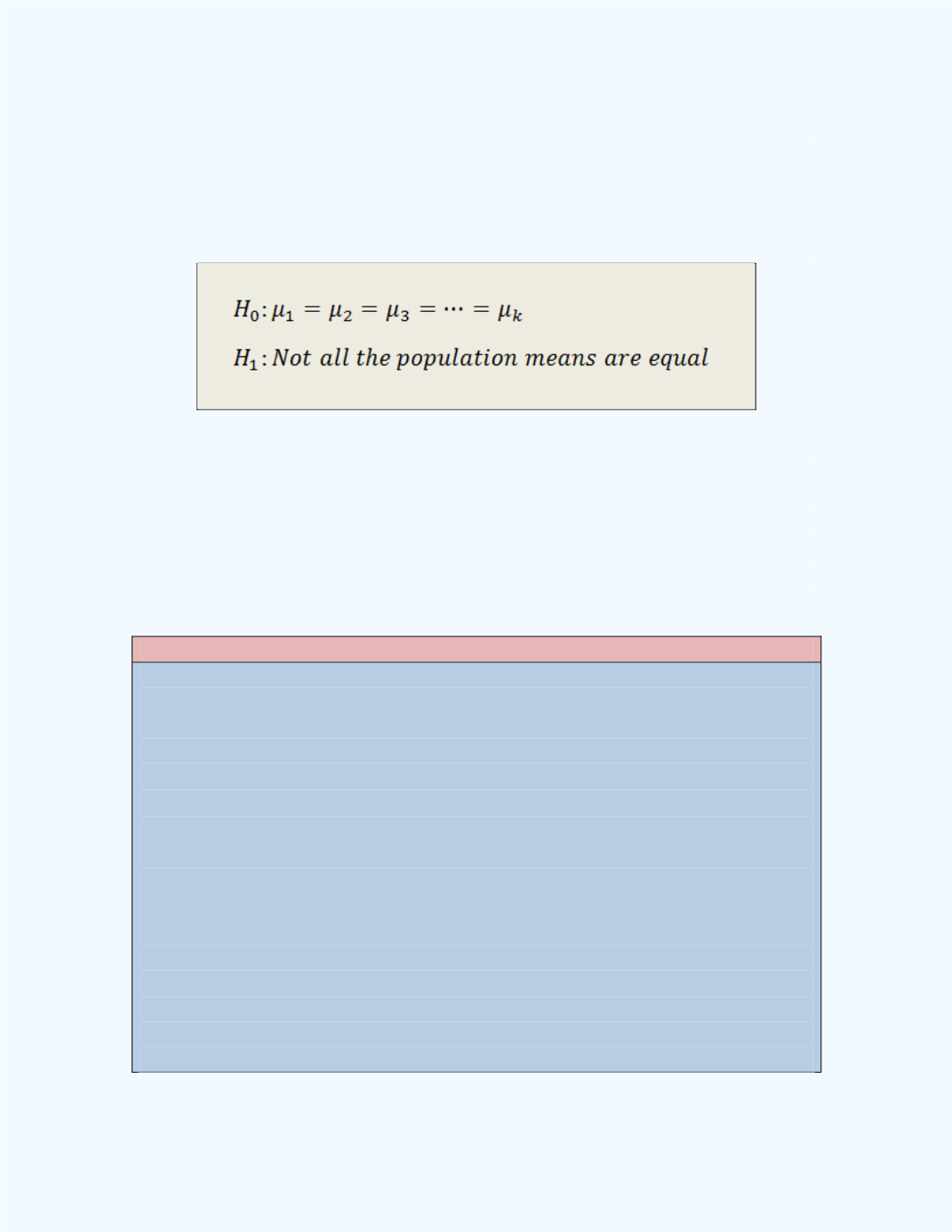
The hypotheses which are associated with the one-way analysis of variance
are given next.
The Null and Alternative Hypotheses for the one-way analysis of
variance
From these
samples several different quantities will be computed which
will help in calculating the test statistic when we assume that the null
hypothesis is true. From the value of the test statistic and the critical value
for a given level of significance, we will be able to determine whether to
reject the null hypothesis or not. That is, we will be able to determine
whether we can conclude that there is no difference between the population
means or there is a significant difference between them.
Notes:
When using the ANOVA technique to test for equality of population means,
we usually would want
> 2.
If
= 2, we can use the simpler two-sample
t
test.
The null hypothesis is called a joint hypothesis about the equality of
several population means (parameters).
It would not be efficient to compare two population means at a time to
achieve what the ANOVA test will achieve.
If we test two population means at a time to achieve what ANOVA
will achieve, we will not be sure of the combined probability of a
Type I error for all the tests.
By using the ANOVA technique to compare several population means
at the same time, we will have control of the probability of a Type I
error.