



 723 / 762

Chapter 16: One-Way Analysis of Variance
723
In order for the results of ANOVA to be reliable, there are assumptions for
the theory which should be satisfied. Following are the assumptions for the
ANOVA procedures.
Assumptions of a One-way ANOVA
The required assumptions of a one-way ANOVA are:
The random samples from the
populations are independent.
The
random samples are assumed to be selected from
normal
populations whose means may or may not be equal.
The populations have equal variances
This is usually referred to
as the “constant variance assumption”.
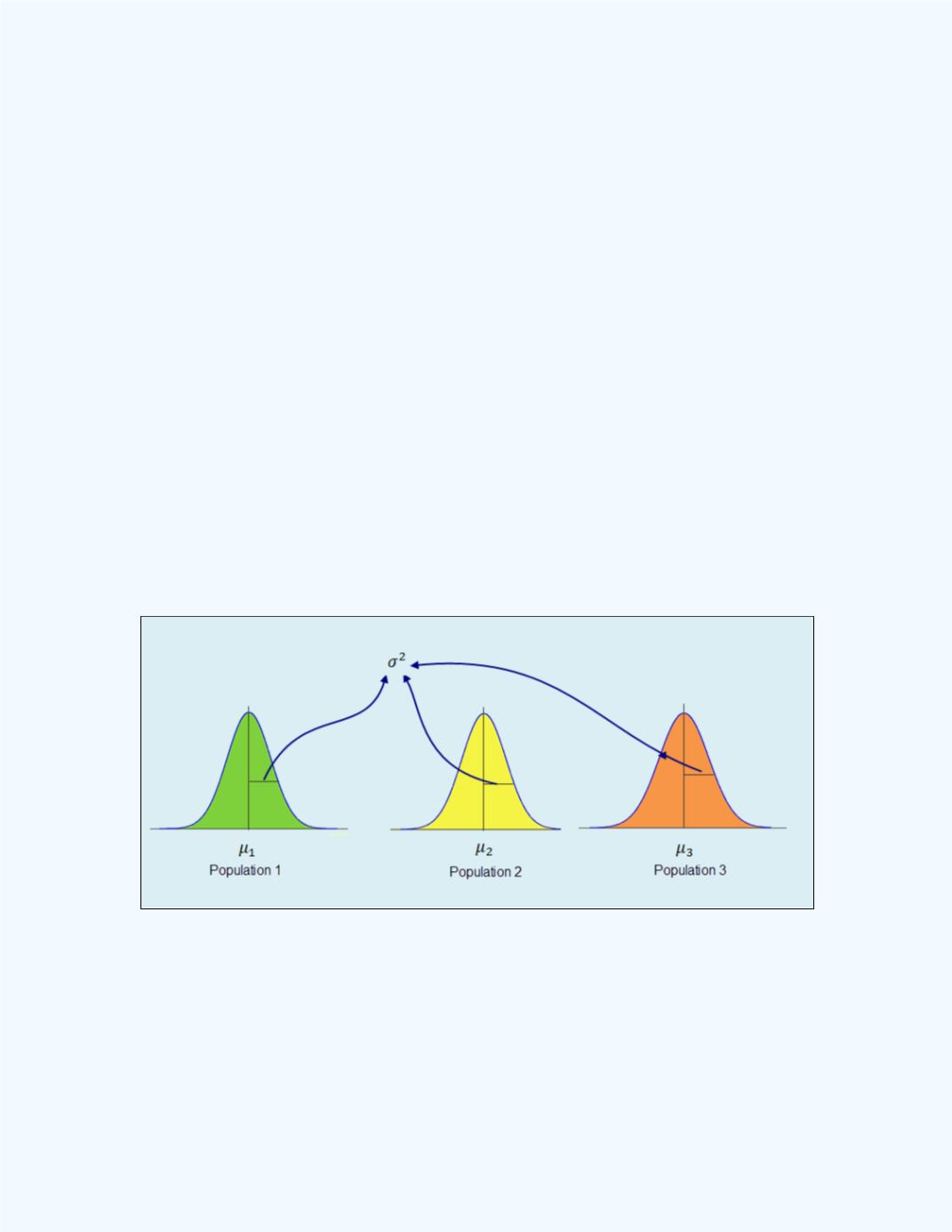
Suppose, for example, that we are comparing three population means
,
,
and
and we want to determine whether these means are equal. For this
experiment, we will select separate independent random samples from each
of the three populations which we assume to be normally distributed with
equal variances.
Figure 16-7
displays this situation.
Figure 16-7:
Three Normally Distributed populations with
Different Means but with Equal Variances
How can we validate these assumptions when we test for the equality of
means for a one-way ANOVA? There are several advanced procedures
which one will encounter in most advanced texts about analysis of variance.
Some of these techniques will be discussed later in this e-book. However,