


 101 / 762

Chapter 3: Measures of Variability
101
Notes:
The range does not use the concept of deviations.
It is affected by outliers (large or small values relative to the rest of
the data set).
The range does not utilize all the information in the data set only the
maximum and minimum values in the data set.
Thus, it is not a very useful measure of spread or variation.
Example 3-2:
What is the range for the following sample values?
996, 1015, 1000, 997, 1001, 1002, 999, 995, 990
Solution:
We can arrange the data values so as to obtain the smallest and
the largest values in the data set. The ordered set is as follows:
990, 995, 996, 997, 999, 1000, 1001, 1002, 1015.
Thus, the sample range =
R
= 1015 – 990 = 25.
The range here is also 25, same as in
Example 3-1
. Note that no information
about the values between the extreme data points are involved in the
computation.
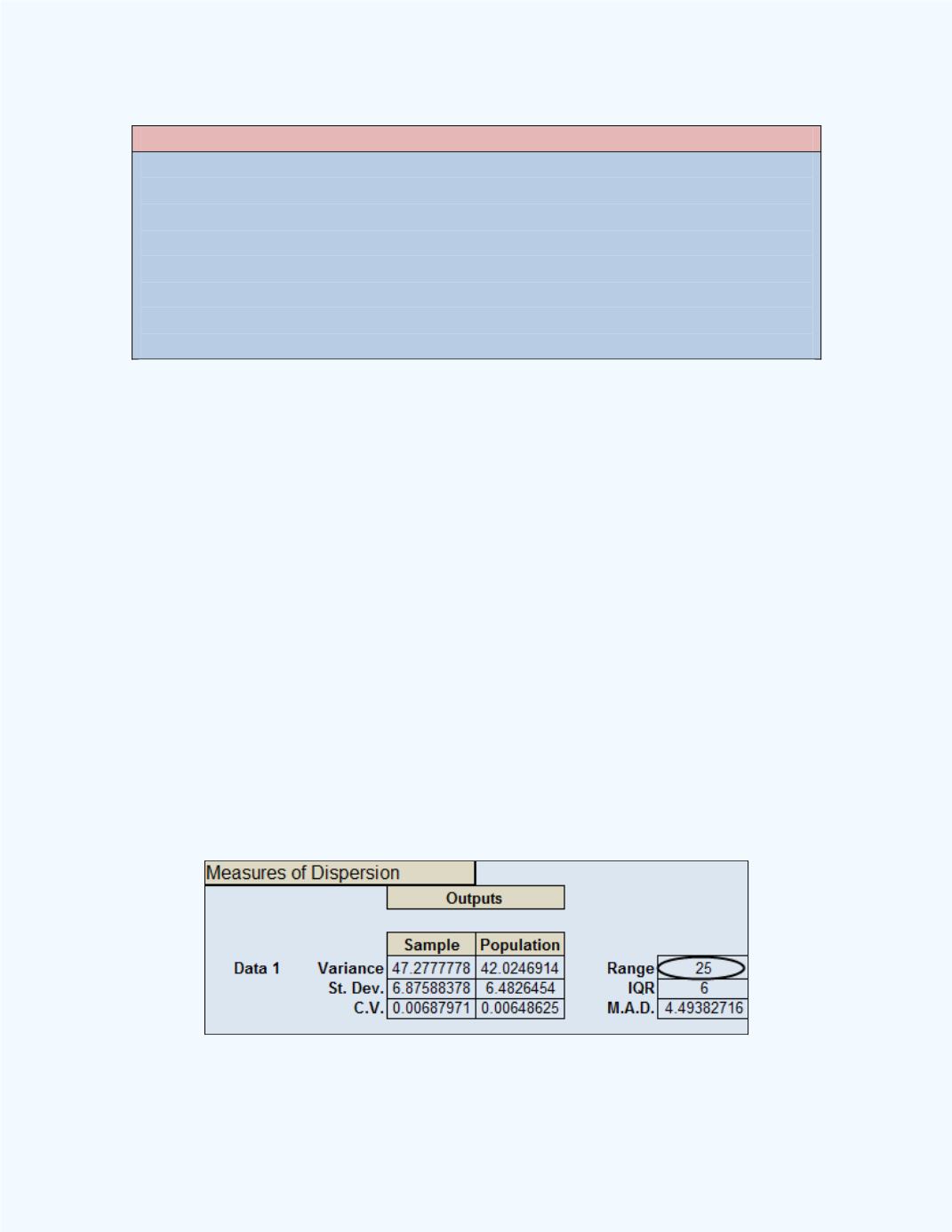
Again, we can also use the
Basic Statistics
workbook to help compute the
range for this data set. Observe the data set was entered in the Data 1
column. The result is shown in
Figure 3-3
.
Figure 3-3:
Computed Range for
Example 3-2