


 121 / 762

Chapter 3: Measures of Variability
121
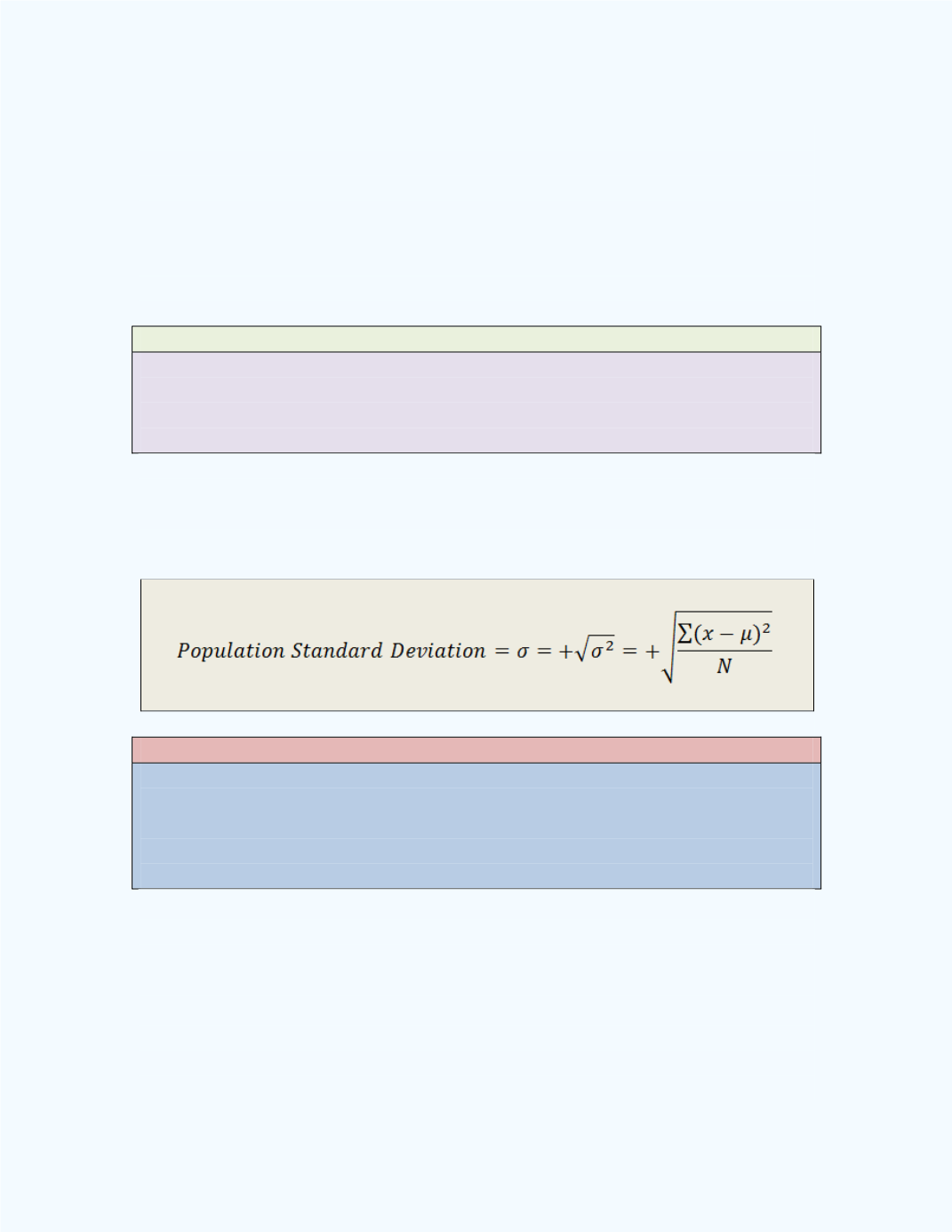
The formula says that you subtract the population mean from each data
value and square the resulting differences. You then add these values
together and divide by the population size.
Just like we can obtain the sample standard deviation from the sample
variance, we can equivalently obtain the population standard deviation from
the population variance.
Definition: Population Standard Deviation
The population standard deviation is the positive square root of the
population variance.
The population standard deviation is computed from the following formula
and is denoted by
(read as sigma). In the formula,
is equal to the size of
the finite population.
Note:
The Basic Statistics workbook also computes the population variance and
standard deviation. So if the data is from a population you will be able to get
those values as well.
Example 3-11:
If the data given in
Example 3-8
represented data from a
finite population, use the
Basic Statistics
workbook to compute the variance
and standard deviation.
Solution:
Using the
Basic Statistics
workbook the variance will be 22 and
the standard deviation will be 4.6904. The results are shown in
Figure 3-16
.
Observe that the data was entered in the Data 1 column in the workbook.