


 123 / 762

Chapter 3: Measures of Variability
123
Notes:
When computing the value of the coefficient of variation, the data
values can be population values or sample values.
Hence we can compute either the population or the sample coefficient
of variation.
Both population and sample data values are assumed to be finite.
First we will deal with the sample coefficient of variation.
Definition: Sample Coefficient of Variation
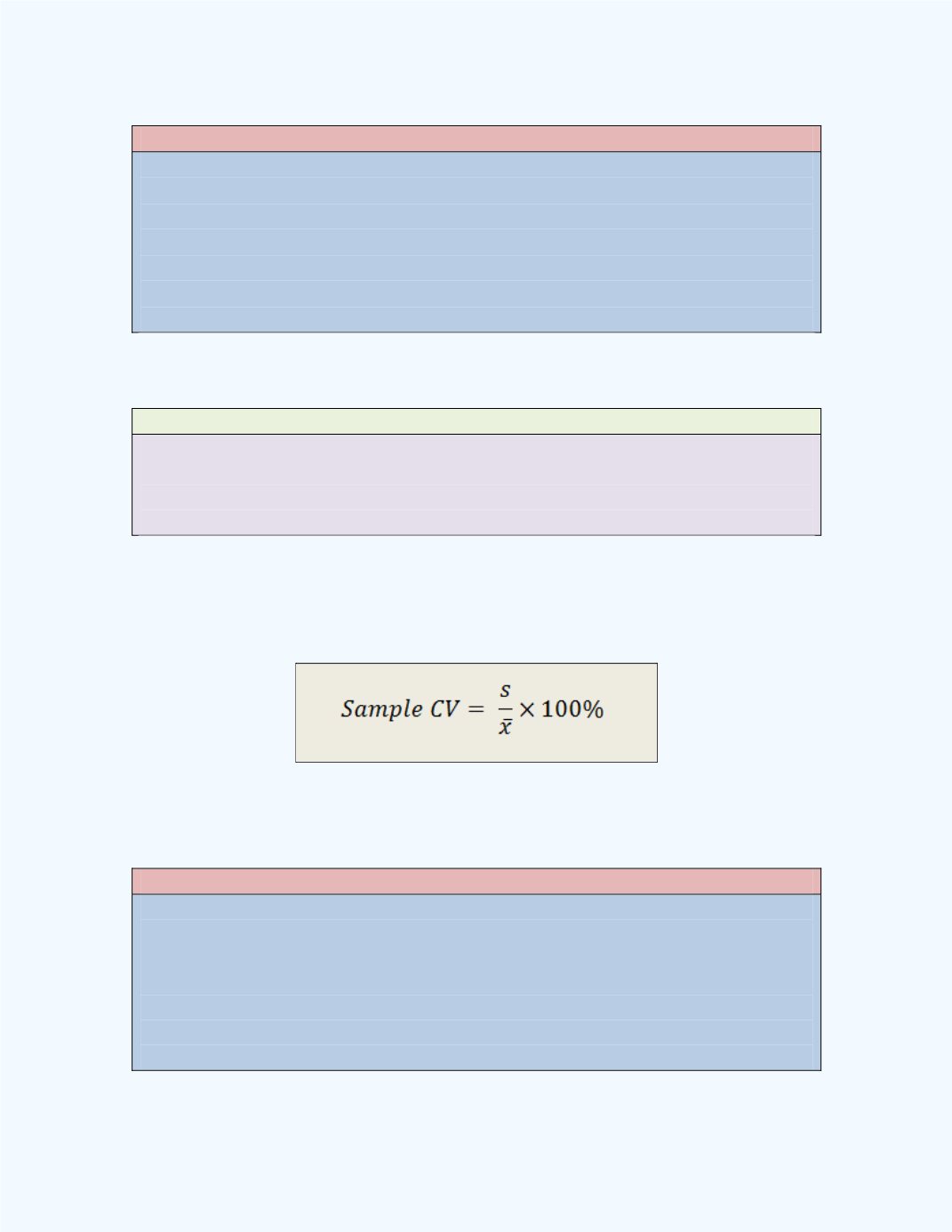
The sample coefficient of variation is defined as the sample standard
deviation divided by the sample mean of the data set.
We will let
coefficient of variation in the discussion.
The formula used to compute the sample
is given next.
That is, the sample coefficient of variation standardizes the variation of the
data by dividing it by the sample mean.
Note:
The coefficient of variation has no units, since the standard deviation and the
mean have the same units and thus cancel out each other.
Because of this property, we can use this measure to compare the variations
for different variables with different units.