


 293 / 762

Chapter 7: Probability
293
Example 7-17:
If a fair six-sided die with faces numbered 1 to 6 is rolled
and
A
is the event of rolling a 2 or a 5, compute
P
(
A
c
).
Solution:
Now,
P
(
A
) = 2/6. Thus,
P
(
A
c
) =
P
{1, 3, 4, 6} = 4/6 = 2/3.
The Complement Rule
Observe that the complement of an event and the event itself are mutually
exclusive. If we are dealing with only a single event in a sample space, then
the union of the event and its complement will be the same as the event of
the sample space. If
A
is the event, then
A
A
c
=
S
, where
S
is the sample
space. Thus
P
(
A
A
c
) =
P
(
S
). Now, the probability of the sample space for
any experiment is 1. That is,
P
(
S
) = 1. So
P
(
A
A
c
) = 1. Since
A
and
A
c
are mutually exclusive, then
P
(
A
A
c
) =
P
(
A
) +
P
(
A
c
). This gives us that
P
(
A
) + P(
A
c
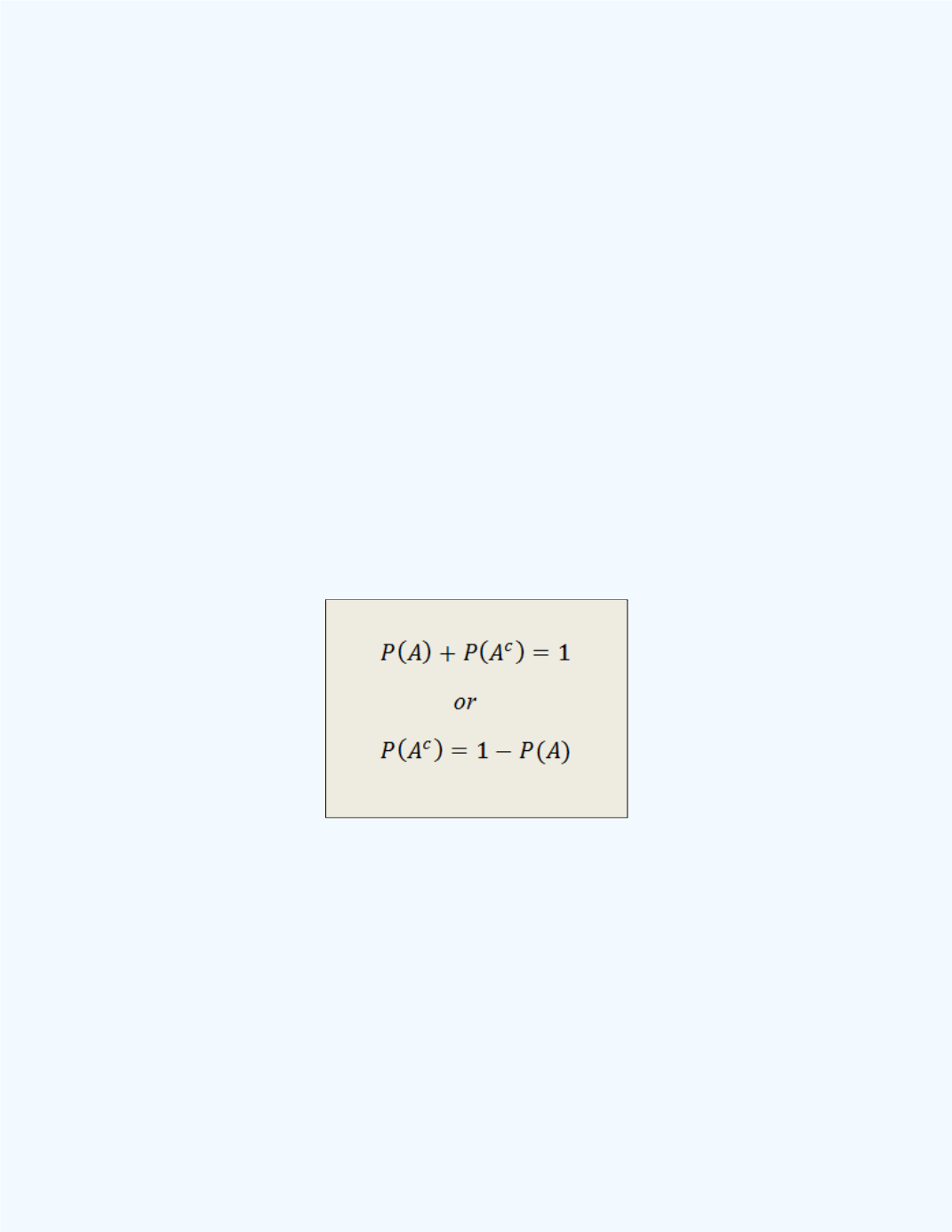
) = 1. We usually state this as a rule.
Rule 6:
The sum of the probability of an event and the probability of its
complement equals 1.
Example 7-18:
The probability of your favorite college basketball team
winning a game is 0.69. What is the probability of the team not winning the
next game?
Solution:
Let
A
be the event that your team wins the next game and so
P
(
A
) = 0.69. Thus
A
c
is the event of your team will not win the next game.
Thus,
P
(not winning the next game) =
P
(
A
c
) = 1 –
P
(
A
)
= 1 – 0.69