


 489 / 762

Chapter 11: Confidence Intervals – Large Samples
489
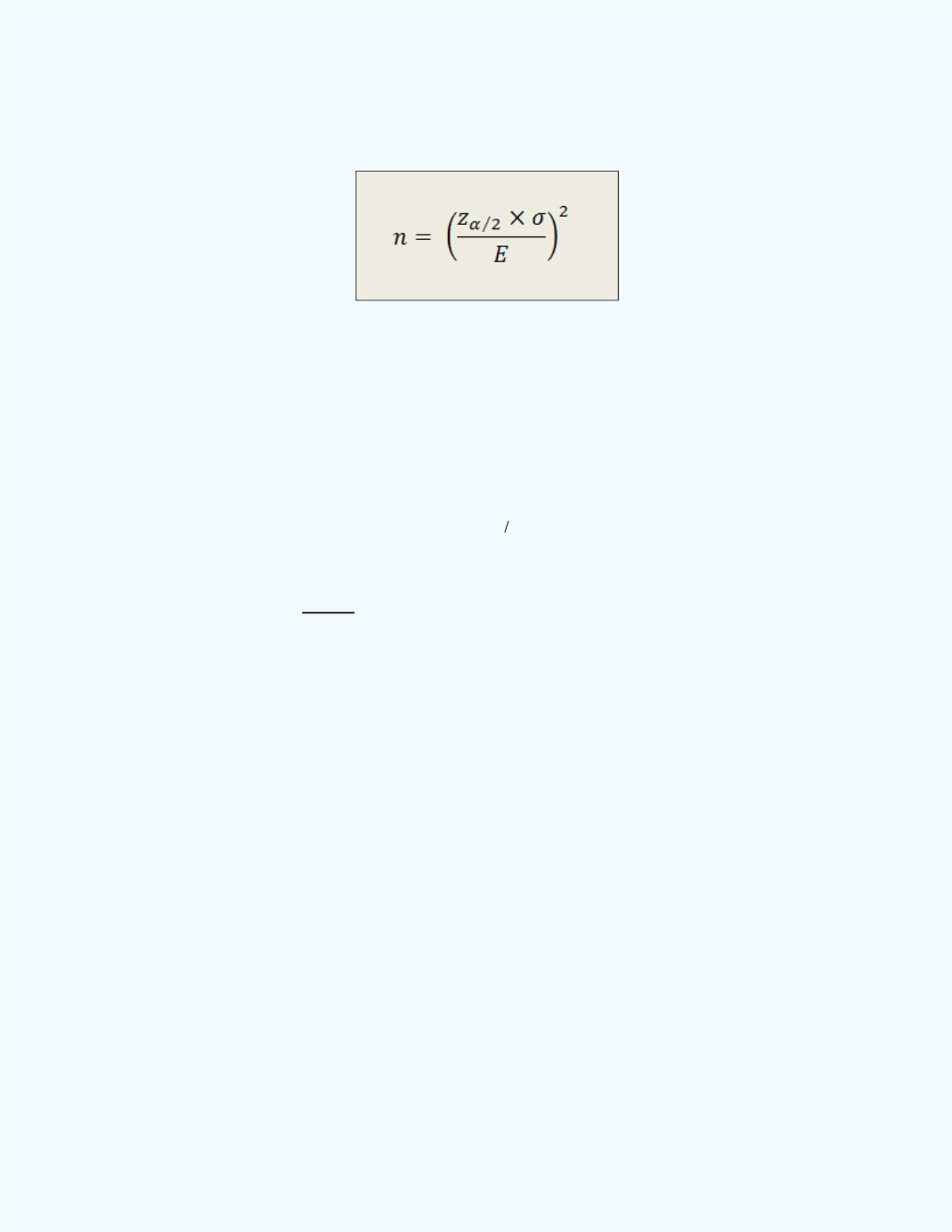
Solving for
n
from the previous equation gives
Note:
When computing sample sizes, you should always round up to the next
whole number.
Example 11-9:
What sample size should be selected to estimate the mean
age of students at a large university within
1 year at a 95 percent confidence
level if the standard deviation for the ages is 3.5 years?
Solution:
We are given that
= 0.05,
2
z
= 1.95996,
= 3.5, and
E
= 1.
Substituting into the formula, we get that the sample size
(
⁄
)
= (1.95996
3.5/1)
2
= 47.057679
48
.
That is, in order to be
95 percent
certain that the estimate is within 1 year of
the true mean age, a sample of at least 48 is needed.
We can also use the
Large Sample Confidence Interval for a Single
Population Mean
to compute the sample size. The output is shown in
Figure 11-13
.