


 525 / 762

Chapter 12: Hypothesis Tests – Large Samples
525
A
P
-value is the smallest significance level at which a null hypothesis can be
rejected.
For the right-tailed test we have presented so far, the
P
-value =
,
where
is the computed test statistic value. So for our example, the
P
-value =
P
(
> 4.4438). From the output of the test in
Figure 12-4
, we see
that the
P
-values are also presented. In this case
P
(
> 4.4438) = 0.0000.
Note:
We can also use the
Normal Probability Distribution
workbook to
compute this probability as well.
We can use the
P
-values to measure the strength of the evidence against the
null hypothesis. The smaller the
P
-value, the stronger the evidence against
the null hypothesis will be for us to reject it in favor of the alternative
hypothesis.
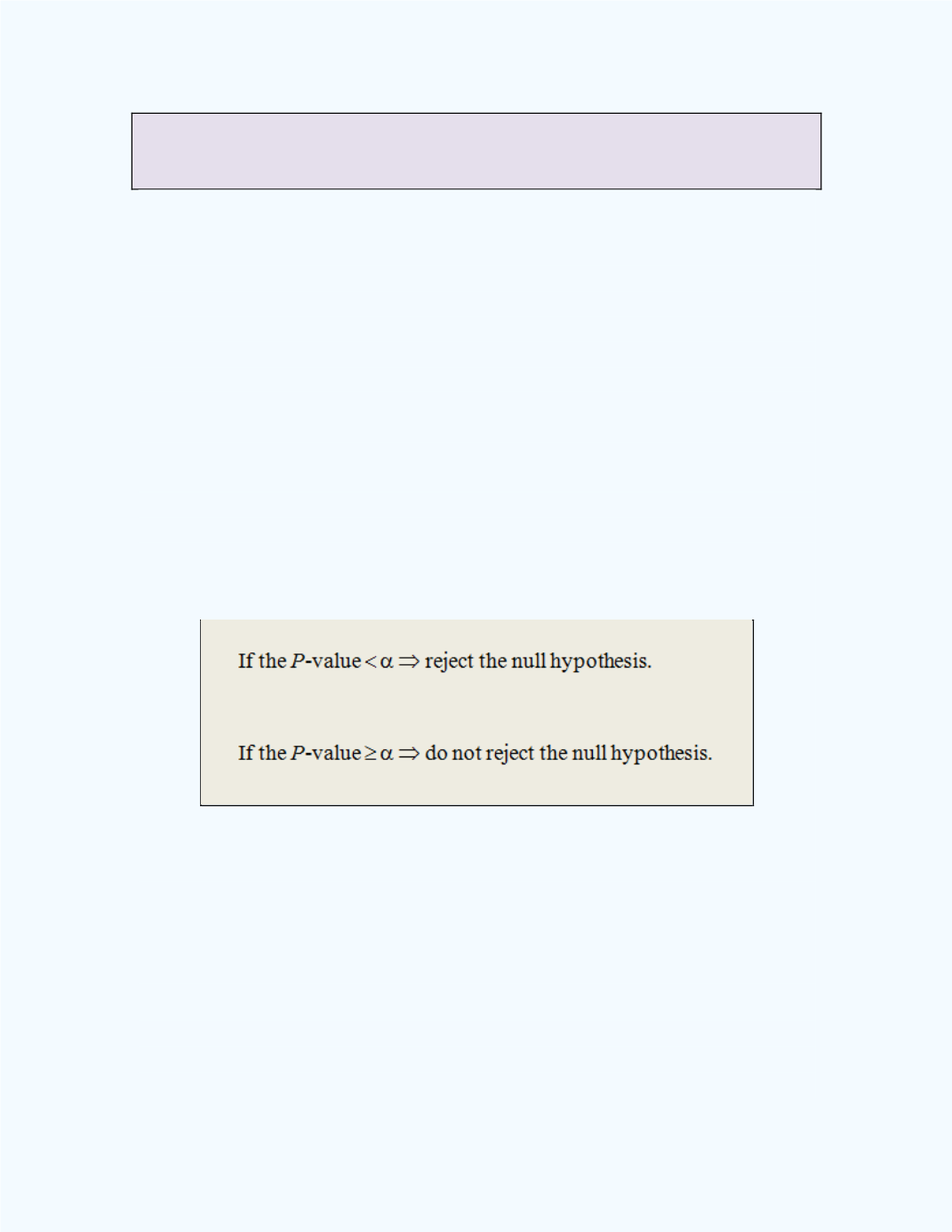
The following can be used to help make your decision when
is the given
significance level.
Using the
P
-value approach for the solution:
0.43
0.43
:
P
-value = 0.0000 (from
Figure 12-4
)
: For a significance level of
= 0.05, reject the null hypothesis if the
computed
P
-value = 0.0000 <
= 0.05.