



 693 / 762

Chapter 15: Chi-Square Tests
693
Section Review
Next we will discuss how we can apply the chi-square goodness-of-fit test to
a natural law referred to as
Benford’s Law
.
15-5 Benford’s Law
In 1881, Simon Newcomb (American astronomer & mathematician) noticed
that the pages of heavily used books of logarithms were much more worn
out at the beginning than at the end.
Reference
: “Note on the Frequency of
the Use of Digits in Natural Numbers”, Amer. J. Math 4, 39-40, 1881. This
suggested, according to Newcomb, that more calculations were done
involving numbers starting with 1 rather than with 8 or 9. Newcomb
postulated that
NATURE
seems to have a tendency to arrange numbers such
that the proportion of numbers starting with a leading digit D is equal to
logarithm of [1 + (1/D)]. In 1938, Frank Benford (physicist at General
Electric) published his paper “The Law of Anomalous Numbers.” Proc.
Amer. Phil. Soc. 78, 551-572. Benford analyzed 20,229 sets of numbers
(e.g. areas of rivers, physical constants, death rates, baseball statistics,
numbers in magazine articles etc.) and showed that these numbers followed
the same law as that proposed byNewcomb. Benford re-discovered the
same law as Newcomb and was given all the credit for it. This formula is
now called
Benford’s Law
or the
First-digit Law.
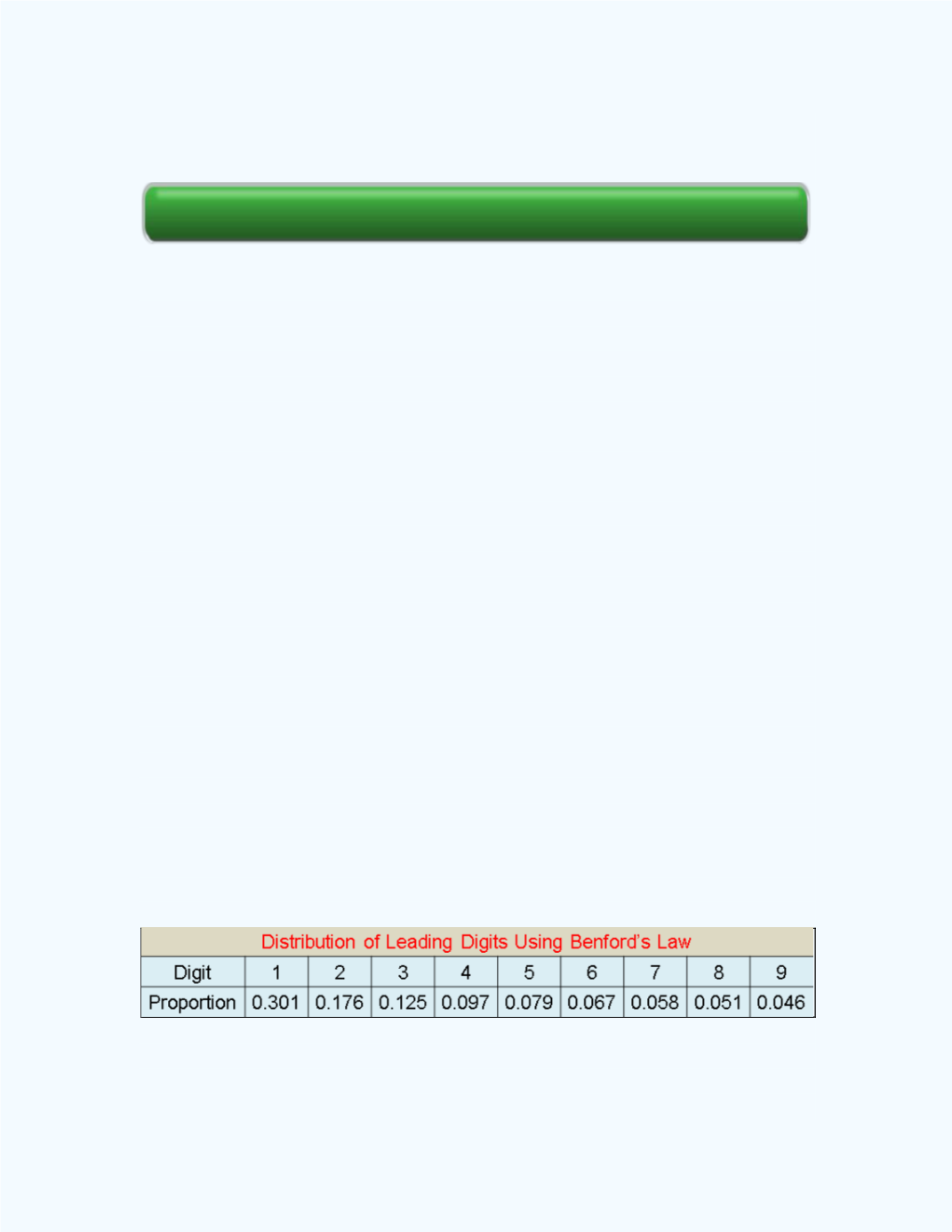
Table 15-10
shows the
distribution of the proportions, to three decimal places, for the leading digits
of numbers based on Benford’s Law.
Table 15-10:
Distribution of Leading Digits Using Benford’s Law
A graphical display of the distribution for the values in
Table 15-10
is
shown in
Figure 15-27
.
e-Self Review